
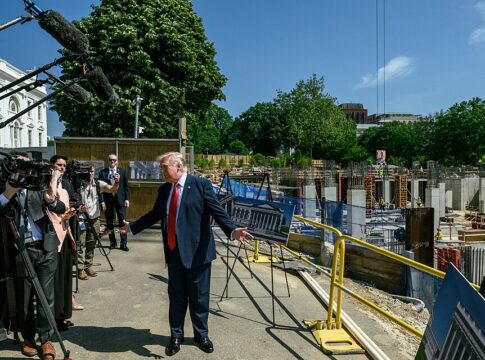
A federal appeals court delivered a decisive blow to President Trump’s ambitious White House renovation plans Friday, ordering an immediate halt to construction of a $400 million ballroom on the White House grounds. The court ruled the massive project cannot proceed without congressional authorization, marking a significant defeat for the administration’s expansion efforts.
Constitutional Clash Over Executive Authority
The appeals court sided 2-1 with historic preservationists who challenged the construction project, which has already begun rising above ground on the east side of the White House complex. The court’s opinion was unambiguous in its reasoning, stating that decisions about constructing massive structures on federal property belong to Congress alone and cannot be accomplished through executive action without legislative approval. The ruling represents a clear check on presidential power over federal property modifications.
The court granted a two-week stay of its order, providing the administration time to seek emergency relief from the Supreme Court. President Trump immediately announced on social media his intention to appeal what he characterized as an unjust decision to the nation’s highest court. The appeals court ruling also encompasses a helipad under construction on the South Lawn, which faces similar congressional approval requirements under the court’s constitutional interpretation.
Project Details and Legal Background
Construction photographs from early August show significant progress on both the ballroom and helipad structures, with the ballroom foundation and initial framework visible in aerial images of the White House South Lawn. The $400 million price tag for the ballroom alone represents one of the most expensive single construction projects ever proposed for the White House complex. Historic preservation groups filed suit arguing the project violated constitutional principles requiring congressional appropriation of federal funds and approval for major modifications to historic federal properties.
What Happens Next
The administration faces a narrow two-week window to petition the Supreme Court for emergency intervention before the construction halt takes effect. If the Supreme Court declines to issue a stay or hear the case on an expedited basis, construction crews will be forced to abandon the site until Congress considers authorizing the project. The legal battle underscores fundamental questions about presidential authority over federal property and the constitutional requirement for congressional oversight of major government expenditures. Whether the current Congress would approve such an expensive renovation project remains uncertain, particularly given ongoing debates over federal spending priorities and fiscal responsibility.
You have to ask yourself, what is the constitutional power of a president? It looks that those Democratic judges have more power than a president. All this distraction cost our Taxpayers billions, because we have hooligans Judges. The time has come that the Supreme Court makes a decision on rough Judges. It has also become imperative that the Congress votes on allowing the President to fire those judges.
Does the judge want them to stop and just leave the current rubble there? Federal judges are our biggest problems today