
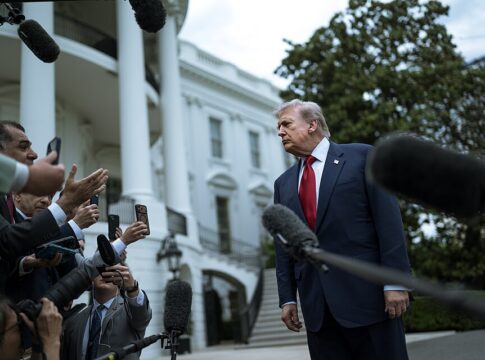
President Donald Trump declined to dismiss the possibility of declaring a national security emergency to federalize election rules before the 2026 midterm elections, telling a conservative media host that “stranger things have happened” when asked about bypassing Congress to impose sweeping voting restrictions.
The Proposal and Trump’s Response
During a Monday interview with Real America’s Voice host Wayne Allyn Root, the president faced a direct question about using emergency powers to unilaterally enforce proof of citizenship requirements, mandatory voter ID, and restrictions on mail-in voting across all federal elections. Root suggested Trump could invoke national security emergency authority to implement the SAVE Act’s provisions without congressional approval, claiming such a declaration could only be overturned by a two-thirds vote in both the House and Senate.
Trump offered no denial of the suggestion, instead responding cryptically. His ambiguous answer aligned with his ongoing push to impose new voting requirements and assert greater federal control over election administration. The president did not elaborate on specific plans or timelines, but the exchange raised immediate constitutional concerns among legal experts.
Constitutional and Legal Barriers
Despite Root’s claims about emergency powers, the president lacks inherent legal authority to alter election rules through executive action. The Constitution grants Congress exclusive authority to determine how federal elections are administered. The Center for American Progress confirmed in March 2026 that no federal executive branch official possesses the power to unilaterally change election procedures, regardless of emergency declarations.
Federal courts have already blocked multiple Trump attempts to reshape voting rules. A federal judge stopped enforcement of an executive order directing states to create citizenship verification lists for voter eligibility. Another court prevented implementation of restrictions on mail-in ballot voting, with a federal appeals court ruling that Trump’s order “directs unprecedented levels of involvement by federal officials in how states administer elections.” The administration recently petitioned the Supreme Court to allow mail-in voting restrictions.
Congressional Standoff Over SAVE Act
The president has expressed mounting frustration over the Senate’s refusal to pass the SAVE Act, legislation critics describe as a voter disenfranchisement effort disguised as election security. The unpopular bill remains stalled in Congress despite Trump’s public pressure campaign. Research demonstrates that noncitizen voting in federal elections is extremely rare, undermining the stated justification for the proposed restrictions. Only U.S. citizens can legally vote in federal elections under current law.
The conversation about emergency powers represents an escalation in Trump’s campaign to reshape American voting procedures, raising questions about potential constitutional overreach as the midterm elections approach.
Sources
Yahoo: Trump doesn’t deny a possible federal takeover of elections: ‘Stranger things have happened’